

Business advisory
Navigating growing business pressures
TC Group’s research highlights the increasing pressure facing UK business leaders and reinforces the growing importance of forward-thinking advisory support from accountancy firms.

The study of more than 1,500* UK business leaders found that just one in eight feel fully in control of their business, as ongoing economic and political uncertainty continues to reshape leadership and decision-making.
TC Group says the findings reinforce its advisory-led approach, as a modern accountancy firm helping business owners make clearer, more confident decisions beyond the numbers.
More than 60% said they cannot confidently plan beyond the next quarter, while 92% said they struggle to switch off from work without feeling anxiety or guilt. At the same time, 72% said they remain confident in their ability to navigate uncertainty or another major disruption.
The findings, published in TC Group’s latest report, Success Without Stillness: Leadership in Motion, point to a clear shift in the needs of modern business leaders. As uncertainty becomes a long-term operating condition rather than a temporary challenge, business owners are increasingly seeking strategic guidance that extends beyond traditional compliance services.
TC Group says the research reflects a wider transformation within the accountancy profession, with firms playing an increasingly active role in helping clients navigate complexity, manage risk and plan for multiple futures.
Stephen Watts, chief operating officer at TC Group, said, “Business ownership has become heavier. Many leaders are carrying more decisions, more responsibility and more uncertainty than ever before, and for some, the reward is becoming harder to justify.
“What this research makes clear is that clients increasingly need more than technical compliance support. They need trusted advisors who understand the wider commercial landscape and can help them make confident decisions in uncertain conditions.
“The role of the modern accountancy practice is evolving. Firms that combine technical expertise with strategic insight, commercial understanding and proactive advisory support will be best placed to create long-term value for clients.”
The report also found that entrepreneurial ambition remains strong but is becoming more measured. Nearly half of business owners said they are more cautious than in previous years, and only 20% said they are willing to take greater risks.
Leaders remain most willing to take risks in areas linked to future growth, including adopting new technology, launching new products and investing in long-term innovation, while being significantly more cautious around hiring senior talent.
TC Group believes this presents a clear opportunity for accountancy firms to deepen client relationships by moving beyond transactional services and providing more strategic, forward-looking support.
Stephen added: “The strongest businesses are not those where one person carries everything alone. They are the ones where responsibility is shared, good people are trusted and the right external support is brought in at the right time.
“That is where advisory-led firms can make a meaningful difference, not by removing uncertainty, but by helping clients respond with greater clarity, stronger foundations and better decision-making.”
TC Group believes the businesses best placed for the future will be those that continue to move with purpose: planning for multiple futures, sharing responsibility across teams and advisors, embracing technology where it strengthens judgement and building mental resilience into the way they lead.
*Research was based on research from more than 1,500 UK business leaders, including 500 TC Group clients and owners (Censuswide)
Zoya Malik (ZM): How AI-ready do you believe businesses and finance functions are today?
Alex Curran (AC): There is enormous pressure on organisations to answer that question now. Boards and audit committees are asking CFOs and CTOs the same thing: "How are we using AI?" Both are expected to have an answer.
But AI readiness isn't simply about acquiring an AI tool. If you simply keep adding endless AI tools, you burn tokens and blow your budget with nothing to show for ROI. Organisations need the infrastructure and the underlying financial information to use AI effectively.
For the CFO, that means real-time, traceable, audit-grade financial data. For the CTO, it means an architecture that can capture and process that data at speed, with governance built in rather than bolted on. Finance data carries a much higher standard of accuracy; nobody audits your marketing data, but they will audit this.
AI has become a trigger for change. The pressure to become AI-ready now looks a lot like the compliance deadlines Aptitude has specialised in for decades. Organisations know they have to respond, because the cost of not responding is competitive ground they will not get back. The ones that fix their finance data foundations first will move faster.
That’s why we built Fynapse, the AI-native Finance ERP. It captures every event in real time at a granular level, so it’s ready for an AI agent to surface the numbers CFOs need on demand.
Jeremy Vokt, CEO, BKR International
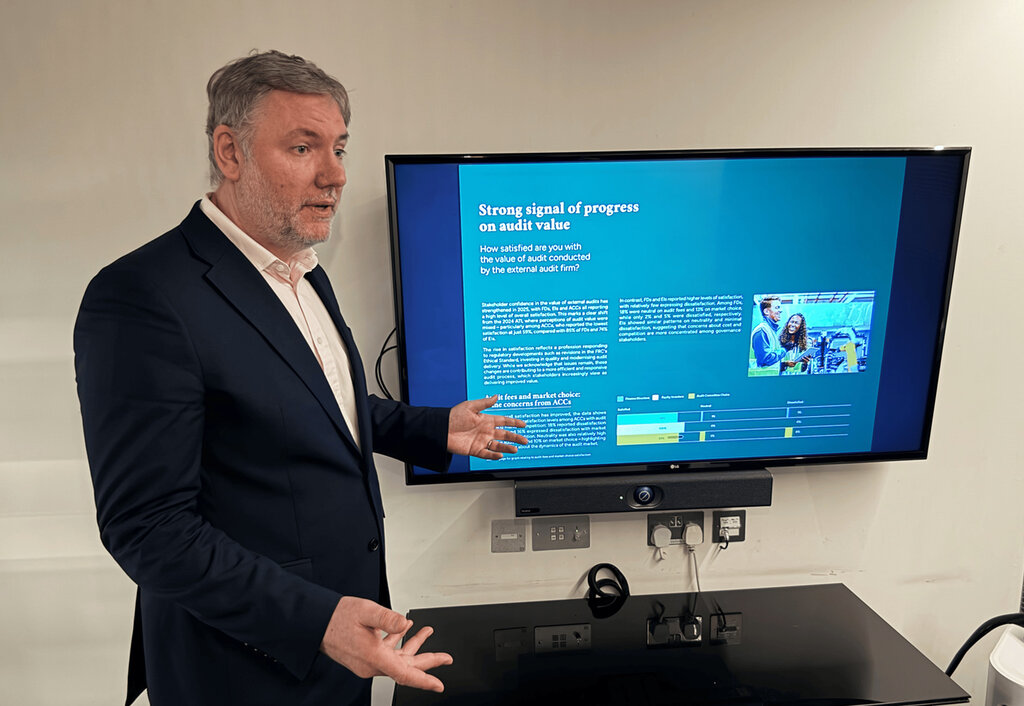
Dean Beale, executive director at CPIA, giving a talk on the 2025 Audit Trust Index.
ZM: How do you define this new category against the traditional ERP model, and why would a CFO need one?
AC: If you go back 10 or 20 years, the decision facing a CFO or technology leader was relatively straightforward. The expectation was that one ERP could support both operational and financial requirements.
It was broadly accepted that finance would operate periodically, that processes would align around the month-end close and that decisions would often be based on retrospective financial information. Systems were built around the process of closing the books and keeping a ledger.
The world has moved on. There is much less tolerance today for technology implementations that take five or ten years. Organisations are, correctly, questioning the cost, duration and success rates associated with major transformation programmes. At the same time, businesses are operating in a far faster paced, high-volume, competitive environment. If the front office wants to launch a new product quickly or enter a new market, finance and the back office cannot become the reason it takes months or years to do so.
AI has compounded all of that. Organisations now recognise that many traditional ERP platforms were built for a different era. It has created the space for AI-native Finance ERP: a financial intelligence architecture capable of supporting real-time processing, trusted finance data and the level of speed organisations increasingly require.
Main image: Stephen Watts, Chief Operating Officer, TC Group. Main video credit: vectorfusionart/Shutterstock.com