

C-Suite Q&A
Building a Globally Connected Network
Zoya Malik, editor-in-chief, IAB speaks with Jason Parker, CEO, Parker Russell about the network’s evolution, operating model, and positioning within the global accounting landscape.
Phil Verity, Member of the Global Network Board and former CEO of Forvis Mazars in the UK, was the winner of the IAFA 2025 Personality of the Year award. He has been an instrumental leader in Forvis and Mazars joining forces, an unprecedented move that created one of the most impressive global networks the accounting profession has seen in decades.
Zoya Malik (ZM): How would you define Parker Russell’s core identity, and what distinguishes it in terms of structure, philosophy, and service delivery from other international networks?
Jason Parker: At its core, Parker Russell is a global network of independent professional services firms that are closely aligned in terms of standards, values, and approach. We are not a loose network; rather, we operate as a coordinated international organisation with a strong emphasis on collaboration, consistency, and skill sharing.
Our identity is built on combining local expertise with international capability. Each member firm has deep knowledge of its domestic market, but through the network, they are able to deliver cross-border services in a structured and consistent way, without excessive layers of decision-making. That balance is what defines us.
Jason Parker, CEO, Parker Russell International
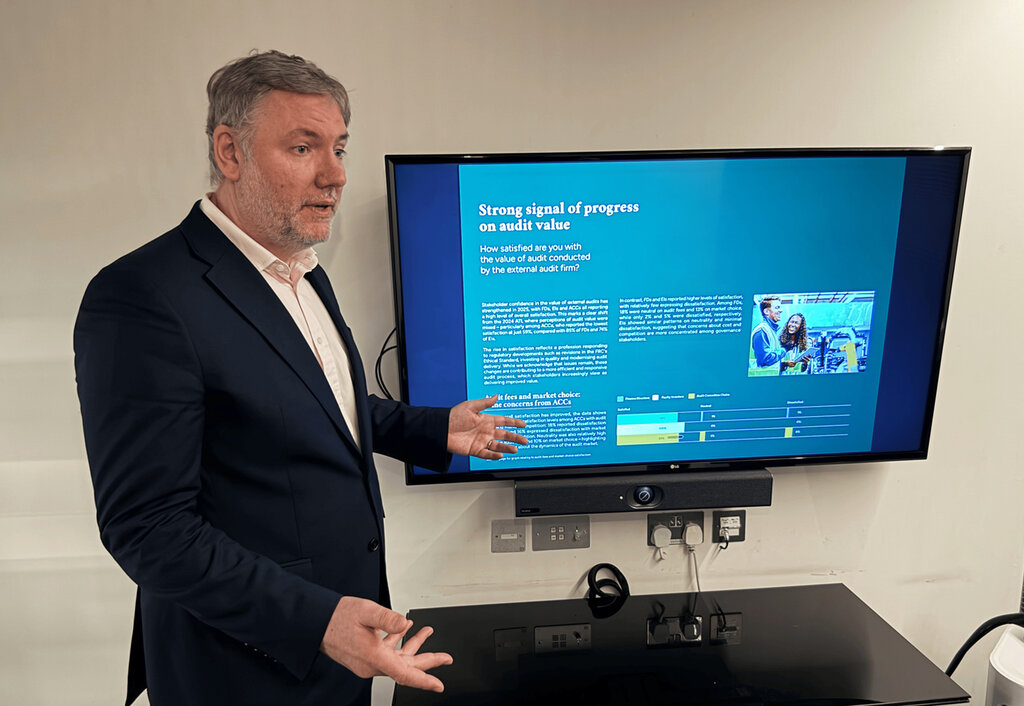
Dean Beale, executive director at CPIA, giving a talk on the 2025 Audit Trust Index.
ZM: How does Parker Russell’s model differ from both traditional networks and emerging private equity-backed platforms?
JP: Many traditional networks operate primarily as referral-based systems, where firms introduce clients to one another but may have limited alignment in methodology or service delivery.
At the same time, private equity-backed models tend to introduce a higher degree of centralisation, with a focus on scale, efficiency, and financial returns. While that can drive rapid growth, it can also change the dynamics of independence and long-term decision-making.
We take a more balanced approach. While our member firms remain independent in terms of ownership, they are expected to operate within a shared framework. This includes aligning on professional standards, collaborating on international engagements, and ensuring a consistent client experience—often with a single point of contact managing the project.
In that sense, we function as a structured international platform, combining coordination and consistency without moving into a fully centralised ownership model.
ZM: How does Parker Russell strategically position itself within the landscape of the dominance of the Big Four and large mid-tier leading firms and how do you differentiate your value proposition for clients seeking alternatives?
JP: The Big Four are highly integrated global organisations with significant scale and centralised systems. They primarily serve large multinational corporations and operate with uniform global methodologies. Private equity-backed firms, meanwhile, are introducing a different type of competition, focused on consolidation, operational efficiency, and growth through acquisition.
We are not attempting to replicate either model directly. However, we do share certain principles, particularly around quality, coordination, and cross-border capability, alongside a strong emphasis on personal, partner-led service.
Our focus is the mid-market: owner-managed businesses, SMEs, and internationally active companies that require global reach but also value accessibility and personalised service. We aim to offer a more flexible, relationship-driven alternative while maintaining strong technical standards.
ZM: In line with Big Four and larger mid-tiers exploring external investment and consolidation strategies?
JP: Networks such as BDO, RSM, and Grant Thornton are well-established global organisations with significant scale and strong international brand recognition. Some are also evolving their models in response to market pressures, including external investment.
Our positioning is somewhat different. We aim to create a closely aligned and highly collaborative network, but without excessive centralisation or external ownership influence. This allows our member firms to retain entrepreneurial independence while still benefiting from international coordination and brand strength.
In many ways, we operate in a space that balances structure with flexibility—more coordinated than traditional networks, but more adaptable than highly centralised or investor-driven global firms.
ZM: Cross-border service delivery is increasingly central to client expectations, particularly for mid-market businesses expanding internationally. In a market where firms are scaling rapidly through acquisition and investment, how does Parker Russell ensure consistency, quality control, and alignment of methodologies across jurisdictions while maintaining its collaborative network model?
JP: Consistency is achieved through a combination of shared expectations, technical alignment, and active collaboration between member firms. When working on cross-border assignments, firms coordinate closely to align methodologies, reporting standards, and delivery timelines. This ensures that clients experience seamless service, regardless of geography.
We also place strong emphasis on knowledge sharing, whether related to regulatory updates, audit standards, or tax developments, which helps maintain a consistent level of quality globally. Importantly, our model allows us to achieve this without relying on acquisition-led growth, which can sometimes create integration challenges.
ZM: From a client perspective, which types of organisations derive the greatest value from Parker Russell’s network model, particularly in comparison to larger, more centralised or private equity-backed firms?
JP: Our core clients are medium-sized enterprises, owner-managed businesses, and mid-market international companies. These organisations are often expanding into new jurisdictions or managing operations across multiple countries. They need reliable professional support that is globally capable but still accessible and cost-effective.
Many of these clients also value continuity of relationships and direct partner involvement, something that can be more difficult to maintain in highly centralised or investor-driven models.
Our network model is particularly well suited to this segment because it combines local expertise with coordinated international delivery.
ZM: One of the defining dynamics in today’s market is the tension between independence and consolidation, particularly as private equity investment accelerates structural change. How does Parker Russell manage the balance between maintaining member firm independence and ensuring global alignment, and do you see independence as a long-term strategic advantage?
JP: That balance is fundamental to how we operate. Each member firm remains fully independent in terms of ownership, management, and local client relationships. At the same time, membership comes with clear expectations around professional standards, collaboration, and ethical behaviour.
We do see independence as a strategic advantage—particularly in a market where consolidation is increasing. It allows firms to remain entrepreneurial, responsive to local markets, and focused on long-term client relationships, rather than short-term financial objectives.
So, while we are not a single global partnership, we are also not a fragmented network. We are a cohesive organisation built on shared principles and aligned delivery standards.
ZM: How does Parker Russell approach brand development in relation to larger firms, and what does the brand represent?
JP: Brand is important, but it is built differently compared with the largest global firms.
The Big Four and major mid-tier networks have strong global brand recognition developed over many decades, and private equity-backed firms are investing heavily in brand visibility as part of their growth strategies.
Our approach is more relationship-driven. The strength of our brand comes from the quality of our member firms and the trust they build with clients. We focus on ensuring that the Parker Russell name represents reliability, technical competence, and cross-border capability, particularly within the mid-market segment.
ZM: Looking at the broader industry, what do you see as the most significant challenges currently facing international accounting networks, particularly in light of increasing regulation, technological change, and the growing influence of private capital?
JP: One of the main challenges is maintaining consistency across diverse regulatory environments while respecting local market requirements.
In an increasingly interconnected business environment, professional services firms are under growing pressure to deliver seamless cross-border solutions while maintaining strong local expertise. At the same time, the sector is undergoing structural change, with private equity investment reshaping ownership models and accelerating consolidation across many markets.
Parker Russell International is one such network that has positioned itself to respond to these dynamics through a coordinated global structure of independent firms.
Another is differentiation. The market is highly competitive, with pressure from large global firms, mid-tier networks, and increasingly, private equity-backed platforms. Networks must clearly articulate their value proposition.
There is also the ongoing need to invest in technology, talent development, and knowledge sharing to remain competitive in a rapidly evolving professional landscape.
At the same time, firms need to carefully consider how ownership structures and investment models impact long-term strategy and client relationships.
ZM: What is your long-term vision for Parker Russell?
JP: Our vision is to continue strengthening and expanding the network both geographically and operationally. We aim to enhance collaboration between member firms and further improve consistency in service delivery across jurisdictions.
Ultimately, our goal is to be recognised as a globally connected, highly coordinated network that combines international capability with local insigh, while maintaining the independence and entrepreneurial spirit of our member firms.
We believe that, particularly as more businesses seek alternatives to both the Big Four and highly consolidated models, there is a strong opportunity for networks like ours to play an increasingly important role globally.
Main video supplied by Ilia Levchenko/Creatas Video+ / Getty Images Plus via Getty Images