AI impacting Finance Teams
AI in the Finance Team: Disruption, opportunity and the human equation
AI isn’t looming on the horizon – it’s already embedded in finance functions across industries. Cyrus Suntook, Associate Fellow at Saïd Business School at the University of Oxford, and Paul Prendergast, CFO & Enterprise Value Lead at Accenture Europe, discuss the impact of AI on finance team functions and human headcount, as businesses learn where automation and insight will intersect for optimal productivity.

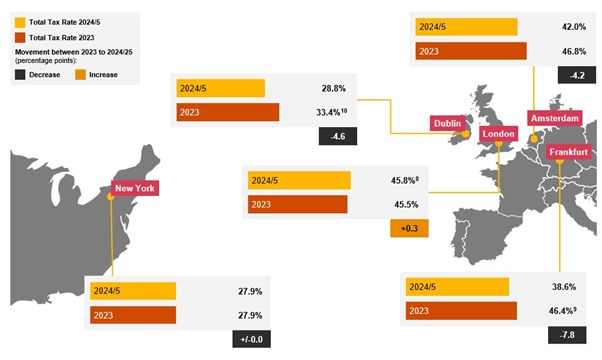
The UK banking sector contribution to government overall tax receipts is at a decade-long high. Specifically, the banking sector now contributes 4.7% of total UK government tax receipts.
The Robots Are Here
From manufacturers automating month-end close to retailers using machine learning for inventory optimisation, the shift is accelerating. Nearly 60% of finance functions are using AI, and 87% of finance managers have taken on new responsibilities, mostly in technology and transformation.
The applications span all sectors. Consumer goods firms are exploring AI for demand forecasting and planning, though many still favour human oversight for decisions that directly affect supply chains. Manufacturing teams can automate accounts payable and cash flow projections; while in retail, AI supports revenue cycle management and compliance.
While 90% of organisations will use some form of finance AI by 2026, fewer than 10% will reduce headcount. The question isn’t whether finance will change, but whether we’re ready for that change. AI delivers efficiency and insights, but also challenges our assumptions about judgement, talent and accountability in an automated world.

Cyrus Suntook,
Associate Fellow, Saïd Business School, University of Oxford
Paul Prendergast,
CFO & Enterprise Value Lead, Accenture Europe

Where AI Is Already Delivering
AI’s impact in finance is already measurable, spanning four key areas – smarter operations, predictive insights, intelligent automation, and efficient scaling.
Faster, Smarter Operations
AI handles the routine tasks that once consumed teams. Reconciliations that took days now finish overnight. Invoice processing is automated with higher accuracy than ever. Expense systems categorise and flag anomalies without human review.
The results are tangible: organisations with fully modernised, AI-led processes display a 2.4x improvement in productivity and 2.5x higher than average revenue growth4. As machines take over repetitive work, finance professionals are shifting into data-driven, strategic roles.
Sharper, Predictive Insights
AI can now generate predictive management insights that were previously out of reach. Retailers predict demand swings and guide inventory decisions; manufacturers forecast maintenance costs and working capital; agriculture companies estimate crop yields and optimise financial planning.
Still, challenges remain. Consumer goods firms, for example, wrestle with discrepancies between AI-driven forecasts and on-the-ground sales realities. Most still prefer hybrid models where AI provides input but humans retain decision-making power – especially when supply chains or working capital are on the line. Moving from trusted bottom-up forecasts to top-down algorithmic predictions is a major cultural leap, and the necessary “dual-run” phase demands extra resources that many organisations are unwilling or unable to invest.
Intelligent Automation
AI agents now handle more than just data entry. Corporate travel expense systems process receipts and detect policy violations. Healthcare budgeting platforms adjust forecasts in real time based on patient volume. Even complex tasks like intercompany reconciliations are being automated at scale.
AI runs 24/7, flagging exceptions, processing transactions, and generating reports across time zones – freeing human teams to focus on interpretation, intervention and action.
Cost Control & Scalability
AI adoption is surging, nearly doubling in the last year. The value is clear: fewer manual errors, faster cycles, and the ability to scale operations without growing headcount.
Finance leaders have seen significant efficiency gains from AI implementations, though the specific ROI timelines vary by organisation size and implementation scope. More importantly, AI systems can handle volume increases – seasonal spikes in retail, acquisition integrations, or rapid business growth – without requiring proportional increases in finance staff. In an age where finance teams are always being asked to do more (with less), an AI-enabled workforce is a critical capability to achieve the scale required for business growth.
UK banks now contribute almost 5% of government revenue. Credit: Shutterstock
The Risks Finance Leaders Must Grapple With
The upsides are compelling – but responsible leaders must also face the risks head-on. These include, but are not limited to, job displacement, risk management, regulation navigation, and skill gaps.
Job Displacement Is Real – But Nuanced
Automation is reshaping finance roles. Operations, reporting, and even some analytical jobs are at risk. Entry-level finance positions are particularly vulnerable, especially those in accounts payable, reporting, and basic analysis.
However, displacement isn’t the full story. The World Economic Forum projects that by 2030, 170 million new jobs will be created while 92 million will be displaced, resulting in a net increase of 78 million jobs. We’re still in transition – this increase hasn’t happened yet, and leaders need to think strategically and proactively about the people in roles that are at high risk and how to best redeploy them to more future-focused roles.
Model Risk and Explainability
AI can fail catastrophically. The infamous Knight Capital algorithm glitch that lost $440 million in under an hour serves as a cautionary tale. While rare, such failures highlight a broader issue: opacity.
When an AI flags a variance or suggests a forecast change, can the team explain why? In regulated sectors, e.g. healthcare, energy or financial services, explainability isn’t optional. Finance functions need to justify decisions to auditors, regulators and boards. There is also the risk of lack of oversight in model development. One CFO recently shared their concern with using AI models that when something goes wrong, nobody knows how to fix it quickly, because “nobody” wrote it in the first place.
Regulatory Complexity and Data Governance
Finance teams operate in a maze of regulations. The EU’s AI Act affects any company doing business in Europe. UK healthcare teams must comply with GDPR and NHS data protection standards when handling patient-linked finance data. Energy and pharma firms face sector-specific reporting rules.
Training AI requires data – but sharing sensitive financial and employee data raises privacy and compliance risks. The balancing act between data access, confidentiality and fairness is a new frontier for finance and controllership.
Skills and Trust Gaps
Most finance professionals are fluent in Excel, not algorithms, so fear of the unknown is one of the top barriers to AI adoption within organisations. As AI systems proliferate, teams must interpret outputs, understand model assumptions, and recognise when to trust (or question) the machine. Indeed, we know that 95% of workers are crying out for AI skilling opportunities, but only 5% of organisations are doing this at scale.
Industries vary. Tech and consulting firms embrace AI more readily. Insurance and utilities show more caution. But the core challenge is universal: building trust in systems that don’t think like humans and often can’t explain themselves. How organisations deal with this in a meaningful and ethical way is still developing.
Where Humans Still Excel
Despite AI’s strengths, humans retain critical advantages in three vital domains – judgment, trust and ethics.
Judgement and Context
AI recognises patterns, but it doesn’t always understand the nuance behind strategic finance decisions that often hinge on ambiguity, trade-offs and ethical grey zones. Algorithms can’t weigh reputational risk, navigate boardroom politics, or respond to geopolitical shifts.
Senior finance leaders bring not just data literacy, but contextual wisdom – blending numbers with intuition and stakeholder insight.
Trust and Relationships
In areas like wealth management and corporate advisory, trust is still human. Clients may value AI-generated reports, but for complex or high-stakes decisions, they want experienced advisers – people who can listen, explain and reassure.
Empathy, accountability and judgement aren’t programmable. They’re the foundation of long-term financial relationships.
Ethics and Strategic Thinking
AI optimises; humans strategise. Setting ethical boundaries, aligning decisions with values, and navigating risk trade-offs are uniquely human tasks. This is especially critical in ESG, compliance and reputational risk – where “can we?” isn’t the same as “should we?”
As AI becomes more powerful, human oversight becomes more important, not less.
Redesigning the Finance Workforce
Finance isn’t losing talent – it’s evolving. New roles are emerging, and traditional ones are being reshaped.
New AI-Native Roles
There are several entirely new roles that organisations are creating to address this explosion of AI-enabled finance, which might include:
AI Risk Officers, who are becoming essential as organisations grapple with model risk, algorithmic bias, and AI governance. These professionals need to understand both finance and technology, bridging the gap between traditional risk management and emerging AI risks.
Model Explainability Specialists, who help organisations understand and explain AI decision-making to regulators, clients and internal stakeholders. As AI systems become more complex, the ability to translate algorithmic decisions into human-understandable terms becomes invaluable.
AI Ethics Officers, who focus specifically on ensuring that AI applications align with organisational values and regulatory requirements. They're not just technologists – they're stewards of responsible AI implementation in financial contexts.
These roles blend finance, technology, ethics and governance – and they’re growing fast.
Evolving Existing Roles
However, it’s not just about the new roles – existing roles also need to evolve. Analysts are becoming data storytellers and AI interpreters. Risk managers now handle model risk alongside market risk. The role is shifting from “doing the work” to “directing the system”, and where humans shift from being “in-the-loop” to “on-the-loop”.
Progressive organisations are reskilling, not replacing. They’re investing in AI literacy and helping finance professionals transition from process owners to outcome drivers, and demonstrating the mindset of enabling future growth over driving current cost cutting.
Five Actions Finance Leaders Must Take Now
To lead responsibly and effectively in the age of AI, finance leaders should focus on five critical priorities:
1. Build AI-Ready Skills and Mindsets
Equip finance professionals with the knowledge to work confidently alongside AI systems. This includes upskilling in data interpretation, model oversight, and AI fluency – creating comfort and capability with digital tools. Shift the culture from owning processes to owning outcomes.
2. Develop Robust AI Governance Frameworks
Establish clear accountability for AI use in finance. This means putting in place governance structures that define who monitors model performance, flags risks, audits outputs, and ensures compliance. Frameworks must balance innovation with control – especially in regulated sectors.
3. Maintain Human Oversight for Critical Decisions
Not every decision should be automated – as mentioned, just because we can, doesn’t mean we should. Define where human judgement must prevail, particularly in areas involving ethics, strategic trade-offs, or reputational impact. Make human-in-the-loop design a standard principle in AI implementation.
4. Align AI with Organisational Values
Ensure that AI systems reflect and reinforce your values. Build transparency, fairness and ethical standards into the design, training and use of algorithms. Appoint dedicated roles, such as AI ethics leads, to safeguard alignment between technology and purpose.
5. Design for Human–AI Collaboration
Don’t frame AI as a replacement – frame it as a teammate. Redesign finance workflows to optimise human–machine interaction. Use AI to surface insights, highlight risks, and process data, while enabling people to focus on strategic analysis, stakeholder communication, and ethical judgement.
The Way Forward: Collaboration, Not Replacement
The future of finance isn’t about man versus machine – it’s about hybrid. AI has the potential to free humans from routine work, allowing them to focus on what truly matters: strategy, ethics, relationships and leadership.
But getting there requires intentional design, otherwise we risk disaster.
The best finance teams won’t just use AI — they’ll co-create with it, balancing precision and intuition, automation and accountability.
The robots are already here. Whether they strengthen or weaken finance will depend on the leadership choices we make today.
Main image: George Kailas, CEO, Prospero.ai